HITB GSEC 2017 / Published
2017, Dating in Singapore
Reading a string of digits as twelve months of days and tracing them out on the 2017 calendar.
01081522291516170310172431-050607132027162728-0102030209162330-02091623020310090910172423-02010814222930-0605041118252627-0203040310172431-0102030108152229151617-04050604111825181920-0108152229303124171003-261912052028211407-04051213192625
Interpreting the digits as calendar dates
In this challenge, we are only given the above string of characters and nothing else. The word Dating in the title could imply that this challenge has something to do with couples, or it could refer to calendar dates. Since they took the liberty of specifically including the year 2017 in the title, one can only assume that we should be adopting the latter definition.
In [1]: data = '''01081522291516170310172431-050607132027162728-010203020916
   ...: 2330-02091623020310090910172423-02010814222930-0605041118252627-0203
   ...: 040310172431-0102030108152229151617-04050604111825181920-01081522293
   ...: 03124171003-261912052028211407-04051213192625'''

In [2]: len(data.split('-'))
Out[2]: 12
The first observation we made is that we get exactly 12 chunks if we split the string of characters using - as the delimiter. This is very convenient given the definition of Dating that we chose to adopt. There are 12 chunks, and there are (conveniently) 12 months in a year.
In [3]: data = data.split('-')

In [4]: print [map(''.join, zip(*[iter(x)]*2)) for x in data]
[['01', '08', '15', '22', '29', '15', '16', '17', '03', '10', '17', '24', '31'], ['05', '06', '07', '13', '20', '27', '16', '27', '28'], ['01', '02', '03', '02', '09', '16', '23', '30'], ['02', '09', '16', '23', '02', '03', '10', '09', '09', '10', '17', '24', '23'], ['02', '01', '08', '14', '22', '29', '30'], ['06', '05', '04', '11', '18', '25', '26', '27'], ['02', '03', '04', '03', '10', '17', '24', '31'], ['01', '02', '03', '01', '08', '15', '22', '29', '15', '16', '17'], ['04', '05', '06', '04', '11', '18', '25', '18', '19', '20'], ['01', '08', '15', '22', '29', '30', '31', '24', '17', '10', '03'], ['26', '19', '12', '05', '20', '28', '21', '14', '07'], ['04', '05', '12', '13', '19', '26', '25']]

In [5]: data = [map(''.join, zip(*[iter(x)]*2)) for x in data]

In [6]: print sum(data, [])
['01', '08', '15', '22', '29', '15', '16', '17', '03', '10', '17', '24', '31', '05', '06', '07', '13', '20', '27', '16', '27', '28', '01', '02', '03', '02', '09', '16', '23', '30', '02', '09', '16', '23', '02', '03', '10', '09', '09', '10', '17', '24', '23', '02', '01', '08', '14', '22', '29', '30', '06', '05', '04', '11', '18', '25', '26', '27', '02', '03', '04', '03', '10', '17', '24', '31', '01', '02', '03', '01', '08', '15', '22', '29', '15', '16', '17', '04', '05', '06', '04', '11', '18', '25', '18', '19', '20', '01', '08', '15', '22', '29', '30', '31', '24', '17', '10', '03', '26', '19', '12', '05', '20', '28', '21', '14', '07', '04', '05', '12', '13', '19', '26', '25']

In [7]: print set(sum(data, []))
set(['30', '04', '24', '03', '26', '01', '20', '07', '22', '05', '08', '09', '28', '29', '02', '25', '27', '06', '21', '11', '10', '13', '12', '15', '14', '17', '16', '19', '18', '31', '23'])

In [8]: print sorted(set(sum(data, [])))
['01', '02', '03', '04', '05', '06', '07', '08', '09', '10', '11', '12', '13', '14', '15', '16', '17', '18', '19', '20', '21', '22', '23', '24', '25', '26', '27', '28', '29', '30', '31']
Tracing the dates on the 2017 calendar
After manipulating the data further, we made an additional observation that the characters in each chunk, when interpreted as a series of two digit integers, all lie within the range 1 to 31. Once again, conveniently for us, that range corresponds to the number of days in a month. Now here’s where we have to get creative. What’s the best way to consolidate all this information? Perhaps let’s try to use the calendar for year 2017.
Reading each chunk as days of its month and joining consecutive days on that month’s calendar draws one character per month. A jump to a day that is not next to the previous one starts a new stroke.
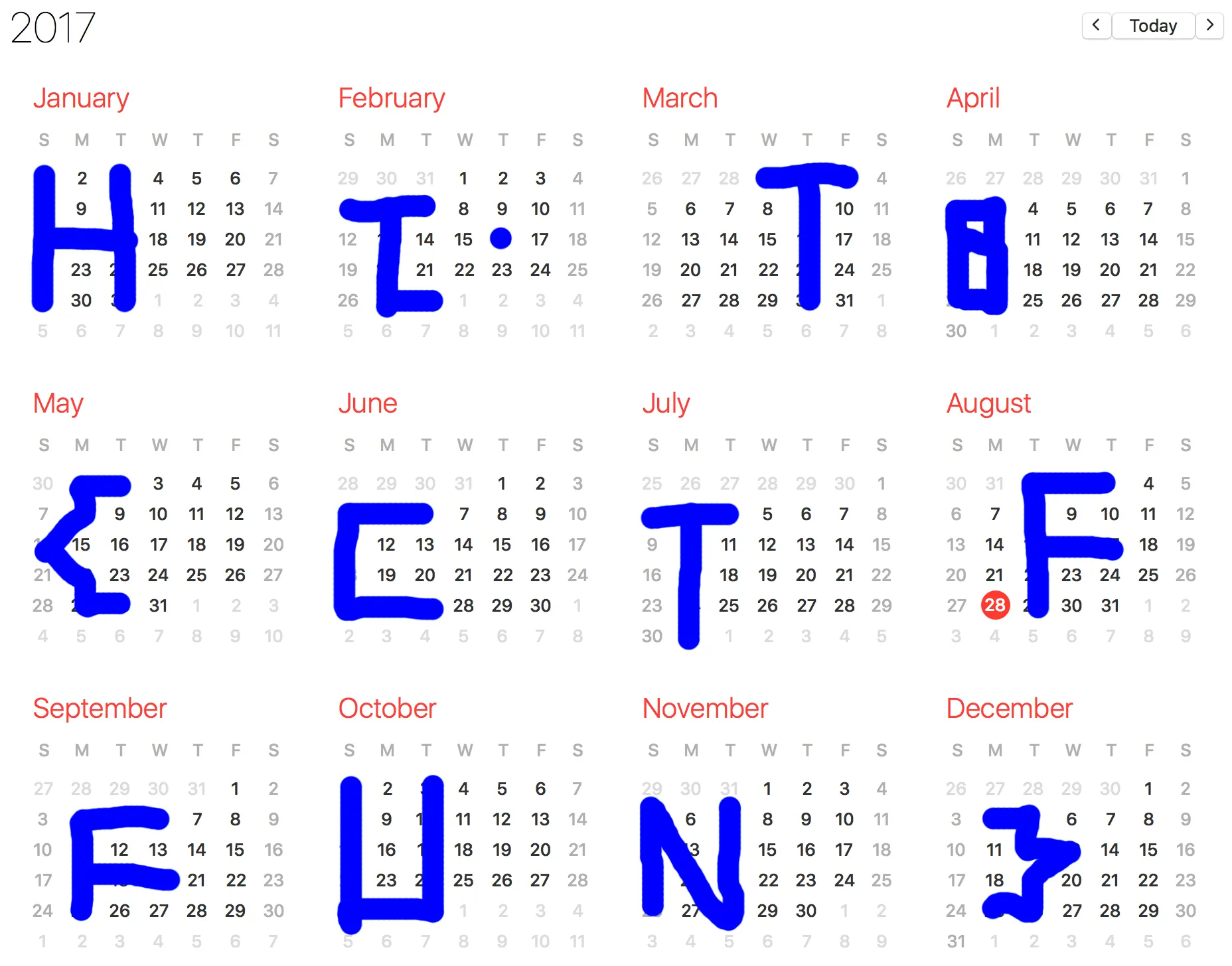
As seen above, the flag can be seen (albeit with a stray dot beside the I) when we trace out the days in the chunks.
Result
Flag: HITB{CTFFUN}